Proper Golf Grip: How to Hold a Golf Club Correctly (Step-by-Step Guide for Beginners)
If your golf ball is constantly slicing into the woods, or if you struggle to generate power off the tee, your hands are likely the culprit. The proper golf grip is your only physical connection to the club. If your grip is flawed, your brain will force your body to make complicated, inconsistent compensations during your swing to square the clubface.
In this guide, you will learn the exact mechanics of the correct golf grip. We will break down the step-by-step process of placing your hands on the club, compare the three most effective grip styles, explain how to optimize your grip pressure, and show you how to troubleshoot common ball-flight issues just by adjusting your hands.
The PGA of America also recommends building a consistent grip before making major swing changes, as grip fundamentals directly influence clubface control.
What is the Proper Way to Hold a Golf Club?
The Quick Answer:
To hold a golf club correctly, place the handle diagonally across the fingers of your lead hand (left hand for right-handed golfers), not in the palm. Close your hand so you can look down and see two knuckles. The “V” formed by your thumb and index finger should point toward your trail shoulder. Slide your trail hand down so the pad of your thumb covers your lead thumb. Connect the hands by interlocking, overlapping, or placing all ten fingers on the grip. Grip pressure should be a 4 out of 10—firm enough to control the club, but relaxed enough to allow wrist hinge.
Grip Element Correct Position Lead Hand Fingers Trail Hand Covers Lead Thumb Grip Pressure 4/10 Visible Knuckles 2 V Position Trail Shoulder
Step-by-Step Guide: How to Grip a Golf Club
Learning how to hold a golf club feels unnatural at first. Follow these five steps exactly. (Note: These instructions are for right-handed golfers. If you are left-handed, reverse the hands).
Step 1: Position the Club
Hold the club directly in front of you at a 45-degree angle. The clubface should be perfectly square, pointing straight up at the sky. Gripping the club while it is suspended in the air makes it easier to position the handle in your fingers rather than resting it heavily in your palms.
Step 2: Place Your Lead Hand (Left Hand)
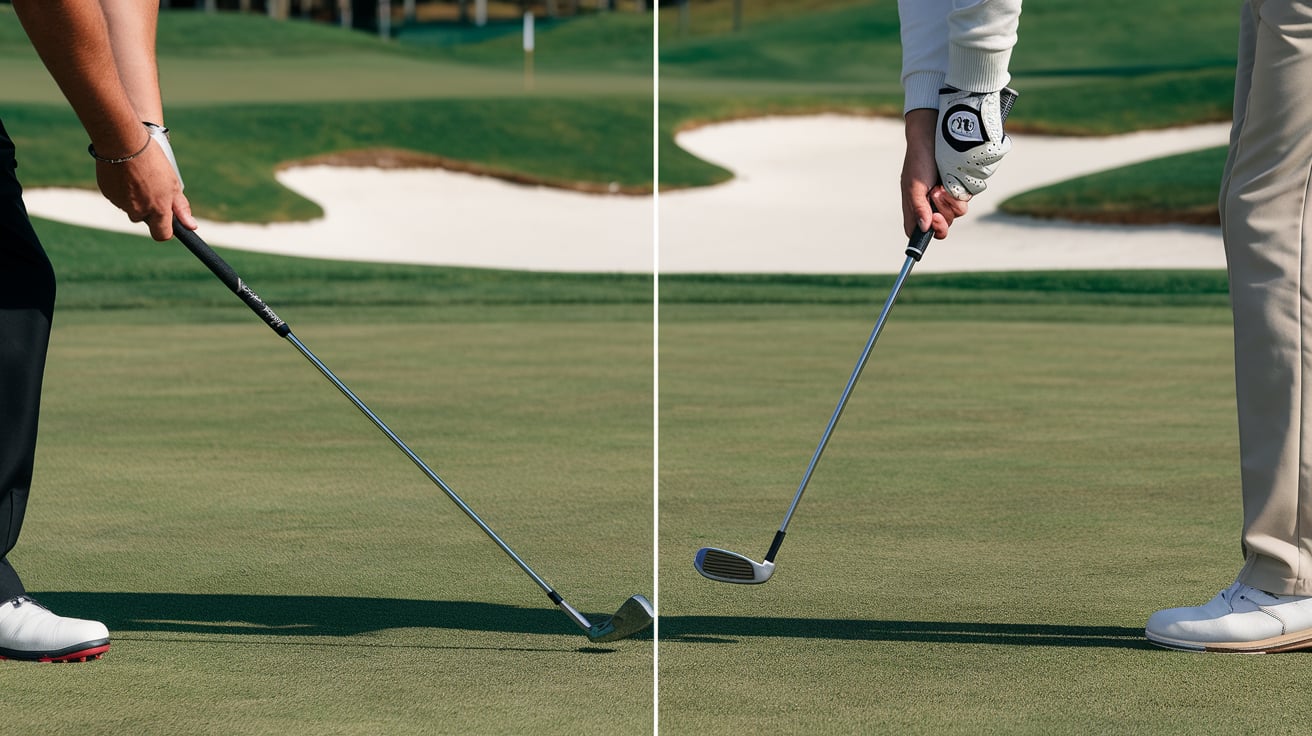
Your left hand is your anchor. Place the grip diagonally across the base of your fingers, starting from the middle joint of your index finger down to the base of your pinky. Wrap your fingers around the club. Do not hold the club deep in your palm; this severely limits your wrist mobility.
Step 3: Check the “V” and the Knuckles
Look down at your left hand. You should clearly see the knuckles of your index and middle fingers. The crease (or “V” shape) formed between your left thumb and left index finger should point toward your right ear or right shoulder.
Step 4: Attach Your Trail Hand (Right Hand)
Bring your right hand to the club. Place the club in the fingers of your right hand, just below your left hand. Fold your right hand over so that the fleshy pad at the base of your right thumb rests directly on top of your left thumb. This locks the hands together, ensuring they work as a single unit.
Step 5: Finalize the Connection
Check the “V” formed by your right thumb and right index finger. It should run parallel to the “V” on your left hand, also pointing toward your right shoulder. Choose your preferred connection style (Overlapping, Interlocking, or Ten-Finger) to finish the grip.
Types of Golf Grips: Which is the Best Golf Grip for You?
There is no single “best golf grip” for every player. The correct golf grip for you depends on your hand size, finger length, and wrist strength. Here is a comparison of the three standard golf club grips.
| Grip Style | How It Works | Best For | Pros & Cons |
| Vardon Overlap | The pinky finger of the trail hand rests in the ridge between the index and middle finger of the lead hand. | Golfers with large hands and long fingers. | Pro: Promotes light grip pressure. Con: Can feel disconnected for those with smaller hands. |
| Interlocking | The pinky finger of the trail hand hooks between the index and middle finger of the lead hand. | Golfers with average to small hands. (Used by Tiger Woods). | Pro: Locks hands tightly together, preventing slippage. Con: Can cause friction or blisters if held too tightly. |
| Ten-Finger (Baseball) | All ten fingers are on the club with no overlapping or interlocking. The hands touch but do not intertwine. | Beginners, juniors, seniors, or players with arthritis/weak hands. | Pro: Maximizes leverage and power for slower swing speeds. Con: Hands can separate during the swing, reducing clubface control. |
Grip Strength: Strong, Weak, or Neutral?
Beyond how your fingers connect, how your hands are rotated on the club dramatically affects your ball flight. Golf grip basics dictate that you can adjust your grip to fix a slice or a hook.
1. The Neutral Grip
- What it is: Both “V”s point slightly toward the trail shoulder. Two knuckles are visible on the lead hand.
- Who should use it: Most golfers. It promotes a straight ball flight and allows for natural wrist release.
2. The Strong Grip
- What it is: Both hands are rotated away from the target (to the right for right-handed players). Three or four knuckles are visible on the lead hand.
- Who should use it: Golfers who struggle with a slice. A strong grip naturally closes the clubface through impact, helping to eliminate a fade or slice.
3. The Weak Grip
- What it is: Both hands are rotated toward the target. Only one knuckle is visible on the lead hand. The “V”s point toward the chin or lead shoulder.
- Who should use it: Golfers who consistently hook the ball. A weak grip restricts wrist rotation, keeping the clubface slightly open through impact.
Grip Pressure: How Tight Should You Hold It?
One of the most frequent questions regarding the proper way to hold a golf club is about grip pressure.
On a scale of 1 to 10 (where 1 is letting the club fall out of your hands and 10 is squeezing it until your knuckles turn white), your grip pressure should be a 4 or 5.
- The Toothpaste Test: Imagine holding an open tube of toothpaste. You want to hold it firmly enough that it doesn’t slip out of your hands, but lightly enough that you don’t squeeze any toothpaste out.
- Why it matters: Squeezing the club tightens the muscles in your forearms, biceps, and shoulders. Tension destroys clubhead speed and prevents your wrists from hinging properly at the top of your backswing.
Does Golf Grip Size Matter?
Many golfers focus on hand placement but overlook grip size. Using the wrong grip size can make it harder to control the clubface, even if your technique is correct.
As a general guideline:
- Standard Grip: Best for golfers with average hand size.
- Midsize Grip: Suitable for golfers with larger hands or those who grip the club too tightly.
- Jumbo Grip: Often preferred by players with very large hands or arthritis because it reduces excessive hand action.
- Undersize Grip: Better for golfers with smaller hands or junior players.
If your fingers dig deeply into your palm when gripping the club, your grips may be too small. If there’s a large gap between your fingertips and palm, the grips may be too large.
Common Mistakes & Troubleshooting
If you are struggling with your ball striking, check for these common grip errors before you change your golf swing.
- Mistake: Palming the Club. Holding the club deep in the palms instead of the fingers.
- Symptom: Fat shots, severe lack of distance, inability to hinge wrists.
- Fix: Pick the club up with only your index fingers and thumbs to force the handle into the finger joints.
- Mistake: The “Death Grip.” Squeezing the handle too tightly.
- Symptom: Slicing the ball, poor distance, sore forearms.
- Fix: Consciously relax your jaw and shoulders before pulling the club back. Soften your grip pressure right before takeaway.
- Mistake: Hands Separating. Leaving a gap between the lead and trail hand.
- Symptom: Inconsistent ball flight, club slipping at the top of the swing.
- Fix: Ensure the life-line of your right palm is completely covering your left thumb.
Expert Tips for the Golf Grip for Beginners
- Regrip Between Every Shot: Do not hold onto the club like a crutch while standing on the driving range. Let go of the club entirely after every single shot and rebuild your grip from scratch. This builds muscle memory rapidly.
- Use a Molded Training Grip: If you are a true beginner, invest in a molded training grip (a rubber grip with pre-molded grooves for your fingers) and attach it to an old 7-iron. Keep it in your living room and practice placing your hands on it while watching TV.
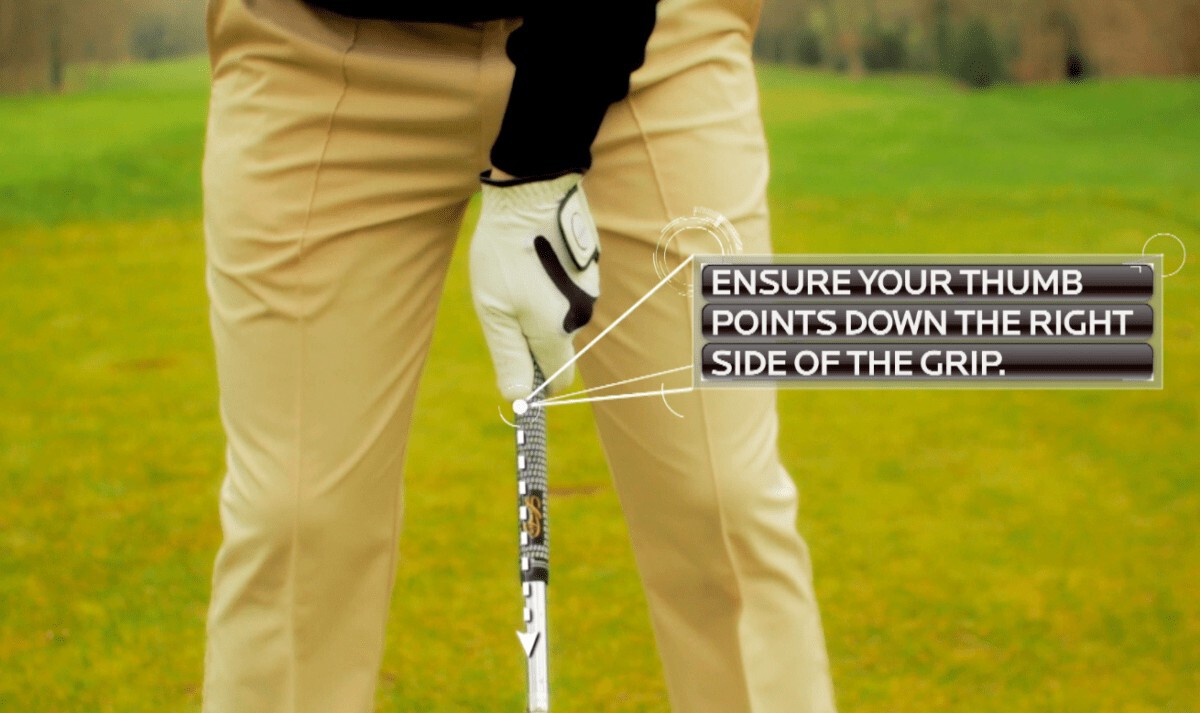
- Check the Logo: Most golf grips have a logo pointing straight down the shaft. When setting up a neutral grip, your left thumb should sit just slightly to the right of that logo, not directly on top of it.
3 Simple Golf Grip Drills to Build Muscle Memory
Changing your grip feels uncomfortable at first, but these simple drills can speed up the learning process.
1. Mirror Drill
Stand in front of a mirror and build your grip without swinging.
Check:
- Two visible knuckles
- Proper “V” position
- Grip pressure
- Hand connection
Repeat 20 times every day.
2. Re-Grip Drill
After every practice shot, completely release the club.
Build your grip again from scratch before hitting the next ball.
This helps create consistent muscle memory.
3. One-Hand Grip Drill
Practice placing only your lead hand on the club.
Then add the trail hand.
Repeat slowly until the movement becomes automatic.
Your Proper Golf Grip Checklist
Before every swing, run through this quick mental checklist:
- [ ] Is the club resting primarily in my fingers?
- [ ] Can I see at least two knuckles on my lead hand?
- [ ] Do the “V”s on both hands point parallel toward my trail shoulder?
- [ ] Is my trail palm securely covering my lead thumb?
- [ ] Is my grip pressure relaxed (4 out of 10)?
Key Takeaways
If you remember only a few things from this guide, make them these:
- Hold the club in your fingers, not your palms.
- Keep your grip pressure light, around 4–5 out of 10.
- Make sure both “V”s point toward your trail shoulder.
- Choose the grip style that best fits your hand size and comfort.
- Practice rebuilding your grip before every shot until it becomes automatic.
Frequently Asked Questions (FAQs)
Should a golf club be held in the palm or fingers?
A golf club should always be held in the fingers, not the palms. Gripping the club in the fingers allows for proper wrist hinge, which is essential for generating clubhead speed and squaring the clubface at impact.
What happens if my golf grip is too strong?
If your grip is too strong (hands rotated too far to the right for a right-handed golfer), the clubface will naturally close too early through impact. This usually results in a severe hook or low, pulling shots to the left.
What happens if my golf grip is too weak?
A weak grip (hands rotated toward the target) makes it very difficult to release the clubhead and square the face. This typically leaves the clubface open at impact, resulting in a slice or a weak push to the right.
Do any pros use a 10-finger baseball grip?
While rare, a few professional golfers, including PGA Tour winner Scott Piercy, have used the 10-finger baseball grip. However, the vast majority of touring professionals use either the interlocking or overlapping grip.
How do I know if my golf grips are too small?
If your grips are too small, your fingers will dig heavily into your palms when holding the club, which can lead to overactive hands and a hook. You may benefit from midsize grips or adding extra layers of grip tape underneath standard grips.
Should your left thumb be straight down the golf shaft?
No. If you place your left thumb directly down the center of the shaft, you are setting up a weak grip. Your left thumb should sit slightly to the right side of the shaft (for a right-handed golfer).
Is Tiger Woods’ grip interlocking or overlapping?
Tiger Woods uses an interlocking grip. He adopted this grip style early in his career, following in the footsteps of his idol, Jack Nicklaus, who also utilized the interlocking grip.
How tight should you grip a driver compared to an iron?
Your grip pressure should remain relatively consistent across all clubs, hovering around a 4 or 5 out of 10. However, some players find success lightening their grip pressure slightly (to a 3 or 4) with the driver to promote faster, more fluid hand speed through the ball.
Why does my golf grip hurt my pinky finger?
If the interlocking grip is causing pain or blisters on your pinky finger, you are likely gripping the club too tightly, or your hands are shifting during the swing. Try loosening your grip pressure or switching to the Vardon Overlap grip to relieve the friction.
Can a bad golf grip cause a slice?
Yes. A weak grip is one of the most common causes of a slice. If your lead hand is turned too far toward the target at address, the clubface will naturally return to the ball in an open position, causing the ball to curve to the right.
Final Thoughts
Mastering the proper golf grip is the single most important step in building a reliable, powerful golf swing. While changing your grip will inevitably feel awkward and uncomfortable for the first few practice sessions, do not revert to your old habits.
Stick to the step-by-step process: keep the club in your fingers, check your knuckles, align your “V”s, and maintain light grip pressure. Within a few weeks, the correct golf grip will feel second nature, and your ball striking will improve dramatically.

Similar Posts