Best Golf Travel Bags for Flying: Top Picks Under $200 & $300

Flying with golf clubs can be stressful. Your clubs have to survive baggage handling, long airport walks, tight connections, and the occasional rough treatment that checked luggage can receive.
That makes a golf travel bag more than just another piece of golf gear. The right one should protect your clubs while also being easy enough to move through an airport.
But you don’t necessarily need the biggest or most expensive travel bag. The best choice depends on how often you fly, how much protection you want, how much weight you are willing to carry, and how easily you need to move the bag.
After comparing the options in this guide, we’ve focused on travel bags for different priorities, including protection, airport mobility, compact storage, and value.
Best Golf Travel Bags for Flying: Quick Picks
| Golf Travel Bag | Best For | Price Category |
|---|---|---|
| CaddyDaddy First Class Premium | Best Overall | Under $300* |
| Sun Mountain ClubGlider Journey | Airport Mobility | Premium |
| CaddyDaddy Enforcer Hybrid | Best Budget Protection | Under $200* |
| Ogio Alpha Mid Travel Cover | Durability | Under $300* |
| Sun Mountain Kube | Compact Storage | Around $300 |
| Motocaddy Flightsafe | Easy Movement | Under $200* |
| BagBoy T-660 | Lightweight Travel | Under $200* |
*Prices can change, so check the current retailer listing before buying.
What Makes a Good Golf Travel Bag for Flying?
A good golf travel bag needs to solve several problems at the same time.
Your clubs need protection from impacts, but the bag also needs to be manageable when you’re moving through an airport. A heavy, awkward bag can become a problem long before you reach the gate.
When comparing golf travel bags, pay attention to these five areas:
1. Club Protection
The top of the bag deserves particular attention because the clubheads and shafts can be vulnerable when the bag is being handled.
Look for substantial padding around the clubhead area, durable exterior materials, and a design that keeps your golf bag secure inside the travel cover.
Sun Mountain, for example, says its travel covers use dense padding and durable fabrics designed to withstand the demands of travel. Its current ClubGlider3 adds a thermoform-molded casing and velour-lined interior for additional protection around the clubs.
2. Weight
Weight matters when flying.
A travel bag that’s already heavy before you put your golf bag and clubs inside can make it harder to stay within your airline’s baggage allowance.
Don’t assume that the lightest bag is automatically the best choice, though. Less weight can sometimes mean less structure or protection.
The better approach is to find the right balance between weight and protection for the type of travel you actually do.
3. Airport Mobility
Moving a fully loaded golf bag through an airport is very different from moving an empty travel cover.
Good wheels can make a major difference.
Some travel bags use conventional wheels, while designs such as the Sun Mountain ClubGlider use a retractable leg system that supports the weight of the loaded bag and pivoting wheels that make it easier to maneuver.
If you regularly have long walks between terminals or gates, mobility should be one of your highest priorities.
4. Durability
Air travel can be hard on luggage.
Look for:
- Reinforced wear areas
- Durable exterior fabric
- Strong zippers
- Reinforced handles
- A secure base
- Good-quality wheels
The goal isn’t simply to find the thickest material. You want a travel bag that can handle repeated trips without becoming difficult to use.
5. Storage
Don’t forget what happens after your flight.
Some golf travel bags take up almost as much space as a regular golf bag when you’re not traveling. Others fold or collapse significantly smaller.
If you live in an apartment, have limited closet space, or regularly travel with other luggage, storage size can be surprisingly important.
Sun Mountain’s current Kube, for example, is specifically positioned as a compact travel cover, while its ClubGlider models prioritize maneuverability and protection.
Best Overall Golf Travel Bag: CaddyDaddy First Class Premium
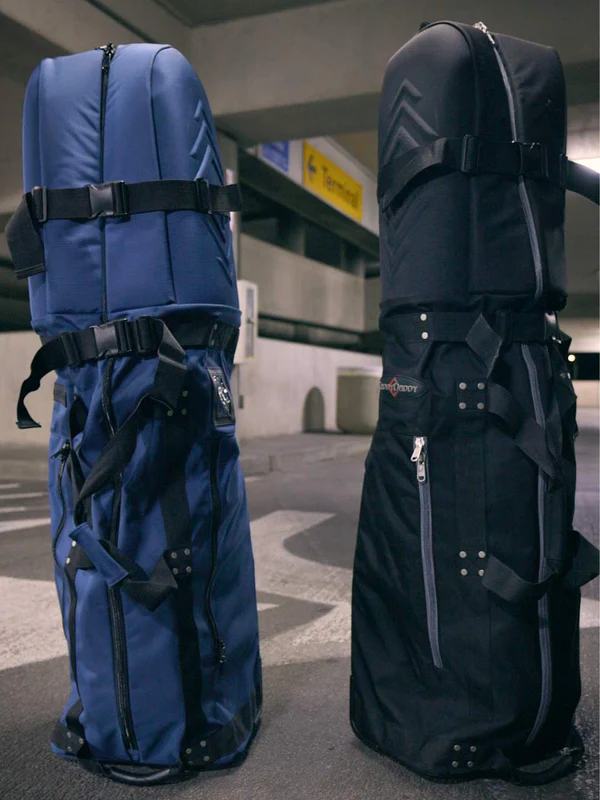
The CaddyDaddy First Class Premium is designed for golfers who want a more substantial travel cover for frequent trips.
Your existing article highlights its 1000D ballistic nylon construction, rolling wheel base, external storage, and airline-damage coverage. Those are useful differentiators, but the warranty and damage-coverage terms should always be checked against the current manufacturer’s or seller’s policy before purchase.
Why It Stands Out
The main appeal of this type of travel bag is durability.
If you’re checking your clubs several times a year, a flimsy cover can become frustrating quickly. A stronger exterior and a more substantial construction can provide greater confidence when your clubs are being transported through the baggage system.
Key Features
- 1000D ballistic nylon construction
- Wheeled design
- External storage pockets
- Designed for frequent golf travel
- Substantial construction
Pros
- Durable construction
- Suitable for frequent travelers
- Good storage capacity
- Wheeled design makes transportation easier
Cons
- More substantial than lightweight travel covers
- May take more storage space
- Current warranty or airline-damage coverage should be verified before purchase
Best For
Golfers who fly regularly and prioritize durability over minimum weight.
Best Golf Travel Bag for Airport Mobility: Sun Mountain ClubGlider Journey
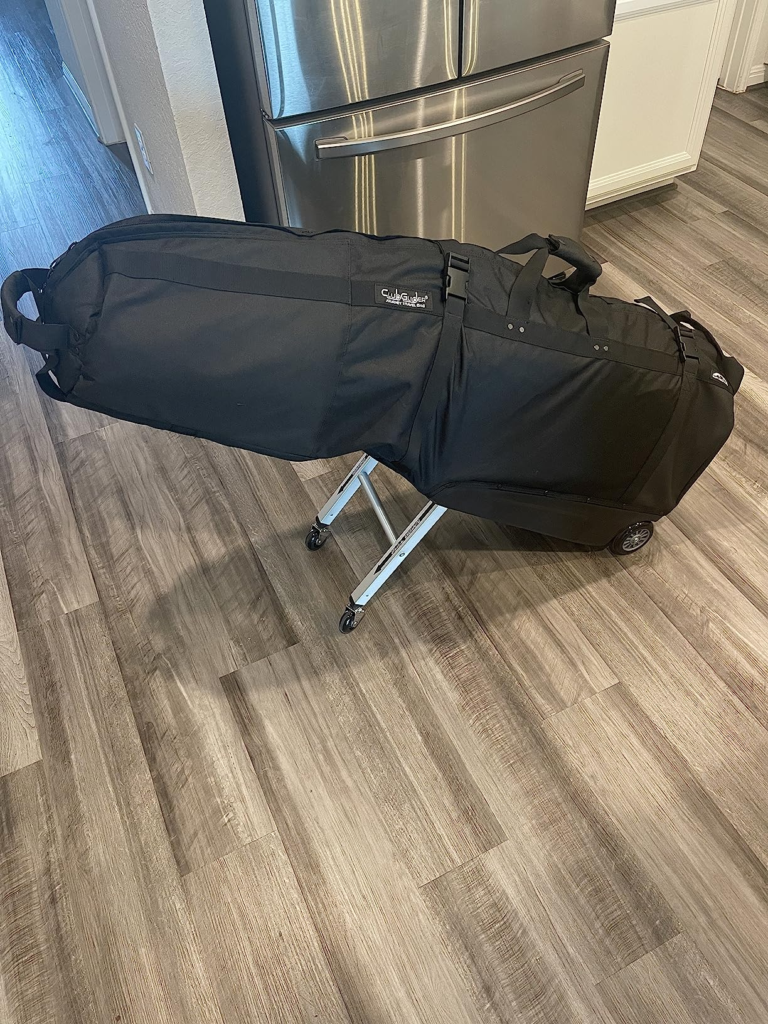
If airport mobility is your biggest concern, the ClubGlider concept is particularly interesting.
The ClubGlider design uses a retractable leg mechanism that supports the weight of the loaded bag. Sun Mountain says the system is designed to make moving a loaded golf bag through airports easier, while the pivoting wheels improve maneuverability.
Why It Stands Out
The biggest advantage isn’t simply that it has wheels. It’s the way the bag’s weight is supported while you’re moving it.
Instead of constantly lifting or dragging the full weight of your clubs, the extended support system and wheels do much of the work.
That can be especially useful when you’re walking long distances through an airport.
Pros
- Excellent airport maneuverability
- Retractable support-leg design
- Easier to move when fully loaded
- Designed specifically around golf travel
Cons
- More expensive than basic travel covers
- The support mechanism adds structure
- Takes more space than a simple lightweight cover
Best For
Golfers who hate dragging a fully loaded golf bag through airports.
Current-model note: Sun Mountain’s current ClubGlider lineup has moved forward from older Journey models. The current Meridian is listed at $380 and weighs 11.3 lb, while the newer ClubGlider3 is $450 and weighs 12.8 lb.
One Important Buying Tip Before You Choose
Don’t choose a golf travel bag based only on its padding or price.
Think about how you actually travel.
If you fly once every few years, paying for a premium travel system may not make sense.
If you fly several times a year for golf, spending more on durability and airport mobility can make much more sense.
And if storage space is your biggest problem, a compact design may be more valuable than maximum protection.
That is why the “best” golf travel bag isn’t necessarily the most expensive one. It’s the one that solves your biggest travel problem without creating another one.
Best Golf Travel Bag Under $200: CaddyDaddy Enforcer Hybrid
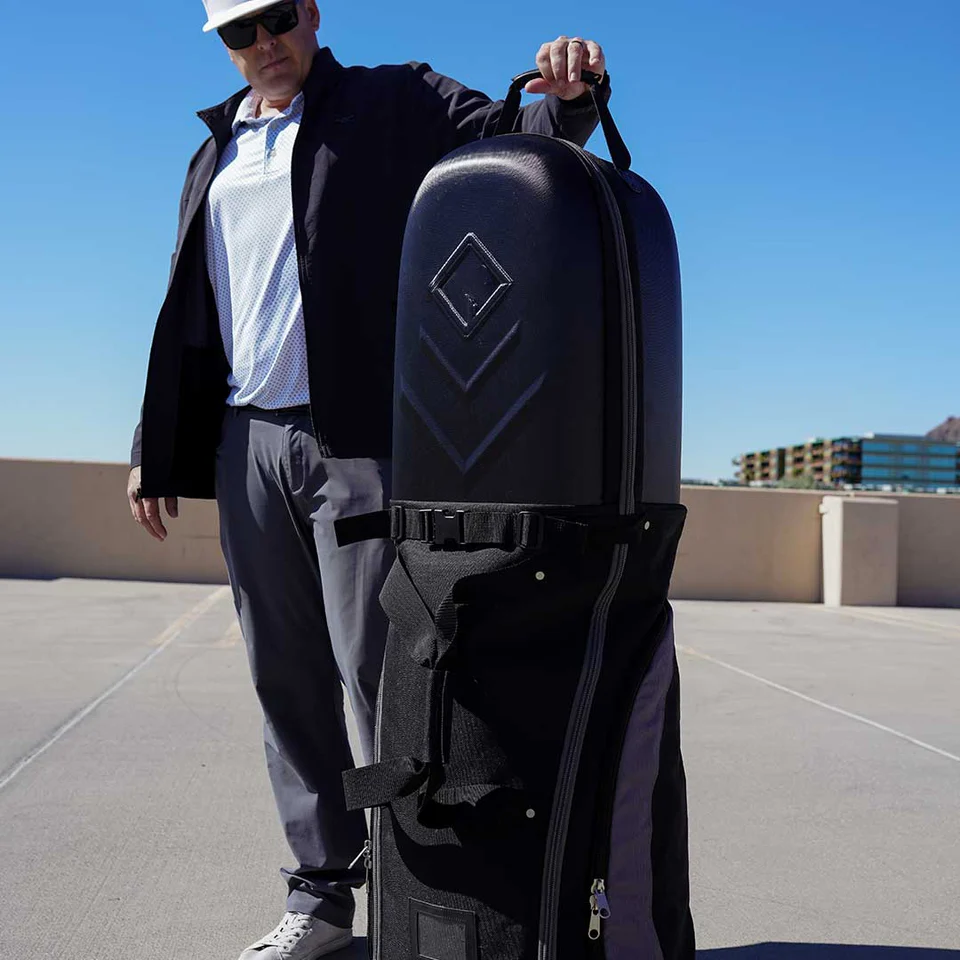
If you want more protection than a basic soft travel cover without moving all the way to a full hard case, the CaddyDaddy Enforcer Hybrid is an interesting middle ground.
The hybrid design combines a more rigid upper section with a softer lower portion. That gives the clubhead area additional protection while keeping the overall design more manageable than a traditional hard case.
Why It Stands Out
The biggest advantage of a hybrid travel bag is the balance between protection and weight.
A full hard case can provide excellent impact protection, but it can also be bulky and inconvenient to store. A completely soft cover is easier to carry and store, but gives you less structural protection.
The Enforcer Hybrid sits between those two approaches.
Pros
- Hybrid construction
- Additional protection around the clubhead area
- Easier to store than many hard cases
- Good option for golfers on a budget
Cons
- Lower section still relies on soft material
- Doesn’t provide the same rigid protection as a full hard case
- Current price can vary
Best For
Golfers who want additional club protection without carrying a full hard-shell travel case.
Best Golf Travel Bag for Easy Movement: Motocaddy Flightsafe
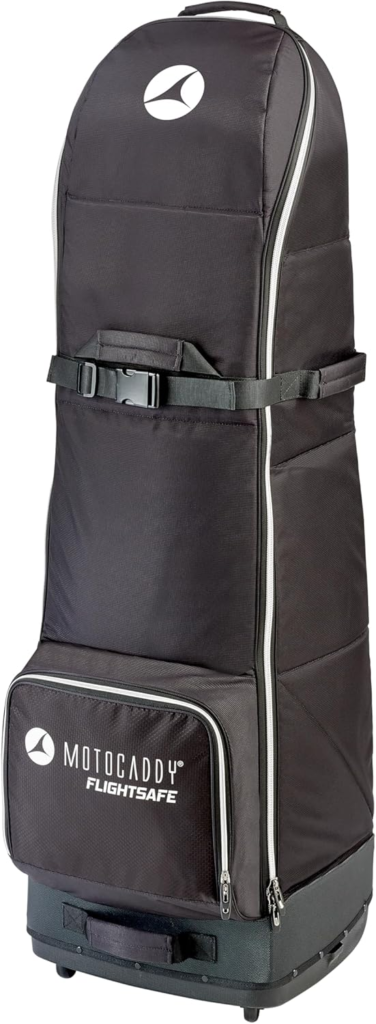
The Motocaddy Flightsafe takes a slightly different approach to airport transportation. Its wheeled design is intended to make moving your golf clubs easier, particularly when you’re dealing with long airport corridors or busy terminals.
Your original article specifically highlights its upright rolling design and internal padding.
Why It Stands Out
Airport travel is one of those situations where small design choices can make a noticeable difference.
A bag that rolls naturally can be easier to control than one that has to be dragged behind you at an awkward angle.
The Flightsafe is therefore worth considering if mobility is more important to you than having the lightest possible travel cover.
Pros
- Easy to maneuver
- Wheeled design
- Internal padding
- Useful for airport travel
Cons
- Can be somewhat bulky
- Availability may vary
- Not the smallest option for storage
Best For
Golfers who want a travel bag that’s relatively easy to maneuver through airports.
Best Lightweight Golf Travel Bag: BagBoy T-660
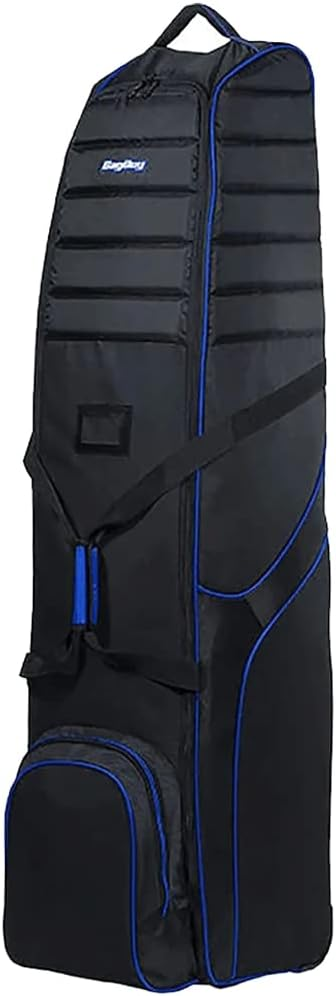
If keeping your travel setup as light as possible is your main priority, the BagBoy T-660 deserves consideration.
A lightweight travel cover can be particularly useful when you’re trying to stay within your airline’s baggage allowance. Every pound saved by the travel bag itself leaves more room for your golf equipment.
Why It Stands Out
The trade-off is straightforward.
A lighter soft travel cover can be easier to carry and store, but it generally won’t provide the same level of rigid protection as a hard or hybrid case.
Your original article recommends adding a stiff arm for additional protection. That’s a sensible consideration when using a lightweight travel cover, because protecting the club shafts and heads should remain the priority.
Pros
- Lightweight design
- Easier to carry
- Easy to store
- Budget-friendly option
Cons
- Less rigid protection
- Thinner construction than heavier travel cases
- May require additional protection for the clubs
Best For
Golfers who prioritize low weight and easy storage over maximum structural protection.
Sun Mountain Kube: Best for Compact Storage
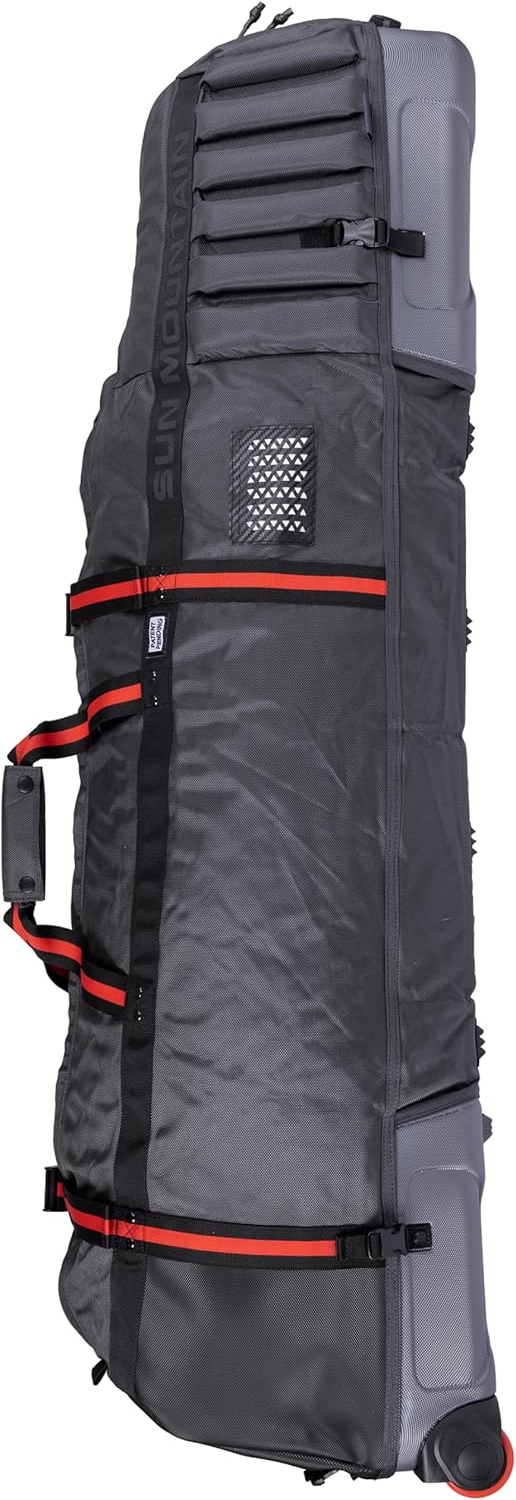
The Sun Mountain Kube is aimed at golfers who don’t want their travel bag taking up a large amount of storage space between trips.
Its compact design is one of its main selling points. When you’re finished traveling, a bag that can be stored efficiently can make a big difference, particularly if you have limited closet or garage space.
Sun Mountain currently lists the Kube as a compact travel cover with a folding design and wheels. The current model is listed at $290 on Sun Mountain’s site.
Why It Stands Out
Most golf travel bags are only used occasionally.
That means storage can be just as important as travel performance.
If you live in a smaller home or apartment, the ability to fold the travel cover down after your trip can be a major advantage.
Pros
- Compact storage
- Folding design
- Relatively easy to transport
- Suitable for golfers with limited storage space
Cons
- Less rigid than a hard case
- Not the best choice if maximum impact protection is your only priority
- Current price is higher than some basic travel covers
Best For
Golfers who want a travel bag that doesn’t become a permanent storage problem.
Hard vs. Soft Golf Travel Bags: Which Is Better for Flying?
This is one of the biggest decisions you’ll make when buying a golf travel bag.
Neither design is automatically better for every golfer.
Hard Golf Travel Bags
A hard case provides a rigid outer shell around your golf equipment.
Advantages
- Strong impact protection
- Rigid exterior
- Less likely to collapse onto the clubs
- Useful for golfers who prioritize maximum protection
Disadvantages
- Heavier
- Bulkier
- More difficult to store
- Can be awkward to move through airports
A hard case can make sense if you fly frequently and are particularly concerned about baggage handling.
Soft Golf Travel Bags
Soft travel bags generally use fabric construction with padding and reinforcement.
Advantages
- Lighter
- Easier to store
- Easier to carry
- Usually more flexible
Disadvantages
- Less structural protection
- Clubheads and shafts may need additional protection
- Quality varies significantly between models
For occasional travelers, a well-designed soft travel bag may provide a better balance of portability, storage, and protection.
What About Hybrid Golf Travel Bags?
Hybrid bags try to combine the advantages of both designs.
The CaddyDaddy Enforcer Hybrid is a good example from this list. Its more rigid upper section adds protection where the clubs need it most, while the softer lower construction helps keep the bag more manageable.
Hybrid bags make sense if you want:
- More protection than a basic soft cover
- Less bulk than a full hard case
- Easier storage
- A compromise between weight and protection
For many golfers, that balance can be more practical than choosing either extreme.
How to Protect Your Golf Clubs Inside a Travel Bag
Even the best golf travel bag cannot completely eliminate the risks of airline handling.
You can improve protection by preparing your clubs properly before checking the bag.
Use a Stiff Arm
A stiff arm or similar support device can help protect the top of the golf bag from impacts and reduce the risk of excessive pressure being transferred to your club shafts.
This is especially worth considering when using a soft travel cover.
Protect the Clubheads
If your clubs have removable heads, consider removing them and storing them safely inside the bag according to the manufacturer’s recommendations.
For clubs with fixed heads, use appropriate headcovers and make sure they are securely fitted.
Secure the Golf Bag
Don’t leave your golf bag loose inside the travel cover.
Use the travel bag’s straps and securing system to keep the golf bag from shifting around during transportation.
Don’t Overpack
Avoid filling every available pocket simply because there’s space.
A heavily overloaded travel bag can become more difficult to handle and may push your total baggage weight higher than expected.
Check Your Airline’s Current Rules
Airline policies can differ considerably.
Before your trip, check the current rules for:
- Golf equipment
- Checked baggage
- Weight limits
- Oversize baggage
- Overweight fees
- Sports equipment charges
Don’t assume that one airline’s golf-equipment policy applies to another airline.
How to Choose the Right Golf Travel Bag for Your Trip
The easiest way to choose is to start with how you travel rather than with the brand name.
If You Fly Frequently
Prioritize:
Durability + protection + mobility
A more substantial bag can make sense if your clubs are traveling regularly.
If You Fly Occasionally
Prioritize:
Value + storage + reasonable protection
You may not need to spend hundreds of dollars on a premium travel system.
If You’re Worried About Club Damage
Prioritize:
Protection + rigid structure + a stiff arm
Don’t choose a lightweight bag simply because it’s easier to carry.
If You Hate Airport Walking
Prioritize:
Wheel design + maneuverability
A good rolling system can make a surprisingly large difference during a long airport connection.
If You Have Limited Storage
Prioritize:
Foldability + compact design
A travel bag that takes up half your closet isn’t ideal if you only use it a few times a year.
One More Thing: Don’t Choose Based Only on Price
A $100 travel bag isn’t automatically a better deal than a $250 bag.
Think about the cost of replacing damaged clubs, the number of flights you’ll take, and how much convenience matters to you.
If you fly once every few years, a basic but well-designed travel cover may be perfectly adequate.
If you’re flying several times each season, better wheels, stronger construction, and more substantial protection can justify spending more.
The right travel bag is the one that gives you the protection and convenience you actually need without paying for features you’ll never use.
Golf Travel Bag Comparison: Which One Should You Buy?
Choosing between these golf travel bags becomes much easier when you focus on what matters most to you.
| Golf Travel Bag | Best For | Main Strength | Main Weakness |
|---|---|---|---|
| CaddyDaddy First Class Premium | Frequent travelers | Durable construction | More bulky |
| Sun Mountain ClubGlider Journey | Airport mobility | Easy maneuverability | More expensive |
| CaddyDaddy Enforcer Hybrid | Budget protection | Hybrid protection | Not a full hard case |
| Ogio Alpha Mid Travel Cover | Durability | Reinforced construction | Heavier |
| Sun Mountain Kube | Small storage spaces | Compact design | Less rigid |
| Motocaddy Flightsafe | Easy movement | Upright rolling design | Can be bulky |
| BagBoy T-660 | Lightweight travel | Low weight | Less protection |
The best choice depends on the kind of golfer you are.
If protection is your priority, look toward a more substantial or hybrid design.
If airport mobility matters most, a bag with a better wheel and support system can make your trip considerably easier.
If weight and storage are your biggest concerns, a lightweight soft cover may make more sense.
Which Golf Travel Bag Is Best for Frequent Flyers?
If you travel with your clubs several times a year, I would prioritize durability and protection over saving a few dollars.
A frequent traveler puts considerably more wear on a travel bag than someone who takes one golf trip every few years.
For that type of use, the CaddyDaddy First Class Premium is the strongest fit from this list because of its substantial construction and travel-focused design.
The Sun Mountain ClubGlider is another strong choice if airport maneuverability is your biggest concern.
Our recommendation:
Frequent flights → prioritize durability, protection and easy movement.
Which Golf Travel Bag Is Best for Occasional Golf Trips?
If you only fly with your clubs once or twice a year, you don’t necessarily need a premium travel cover.
A budget-oriented option such as the CaddyDaddy Enforcer Hybrid can make more sense if you want additional protection without spending as much as you would on a premium travel system.
The BagBoy T-660 is another option if keeping weight and storage requirements low matters more than maximum protection.
Our recommendation:
Occasional travel → prioritize value, storage and adequate protection.
Are Golf Travel Bags Worth It?
Yes, if you fly with your golf clubs.
A normal golf bag is designed to carry your clubs around the course. It isn’t designed to protect them from the handling that checked luggage can experience.
A dedicated golf travel bag adds another layer of protection and makes it easier to transport your golf bag through an airport.
The amount you should spend depends on how often you travel and how much protection you want.
For occasional trips, a simple soft travel cover may be enough.
For frequent flyers, spending more on durability, protection and mobility can make more sense.
How Much Should You Spend on a Golf Travel Bag?
You don’t necessarily need to spend $300 or more.
Under $100
You can find basic soft travel covers designed primarily for portability and storage.
These can work for occasional travelers, but pay close attention to padding, stitching, zippers, handles and wheel quality.
$100–$200
This is where you can find several good value-oriented options, including hybrid designs.
For many recreational golfers, this is the sweet spot between price and protection.
$200–$300+
Premium travel bags tend to focus more heavily on durability, protection, maneuverability and convenience.
If you fly regularly, the additional cost may be easier to justify.
Don’t buy based solely on the price tag. Buy based on how often you’ll use the bag and what you need it to protect.
Golf Travel Bag FAQ
What is the best golf travel bag for flying?
There isn’t one best option for every golfer. For frequent travelers, the CaddyDaddy First Class Premium is a strong overall choice. If airport maneuverability is your biggest priority, consider a Sun Mountain ClubGlider. For golfers who want a balance of protection and value, the CaddyDaddy Enforcer Hybrid is worth considering.
Should I use a hard or soft golf travel bag?
A hard travel case generally provides more rigid protection, while a soft travel bag is lighter, easier to store and more flexible.
If maximum protection is your priority, consider a hard or hybrid design. If portability and storage matter more, a quality soft travel bag may be the better fit.
Are soft golf travel bags safe for flying?
A quality soft travel bag can be suitable for air travel, but it doesn’t provide the same rigid protection as a hard case.
If you use a soft travel bag, consider adding a stiff arm and protecting the clubheads and shafts appropriately.
Should I put my golf bag inside a travel bag?
Yes. A golf travel bag is designed to hold your regular golf bag and clubs during transportation.
Make sure your golf bag is properly secured inside the travel cover so it doesn’t move excessively during handling.
Do I need a stiff arm for a golf travel bag?
A stiff arm can provide additional protection for the top of your golf bag and can help reduce the risk of excessive pressure being transferred to your club shafts.
It’s particularly worth considering when using a soft travel cover.
How do I protect my golf clubs when flying?
Use a suitable golf travel bag, secure the golf bag inside it, protect the clubheads with headcovers, and consider using a stiff arm with a soft travel cover.
Also avoid overpacking the travel bag and check your airline’s current baggage rules before your trip.
Can I use a golf travel bag as a normal golf bag?
No. A golf travel bag is primarily designed for transporting your regular golf bag and clubs during travel. It isn’t a replacement for the golf bag you use on the course.
What should I look for in a golf travel bag?
Focus on:
- Club protection
- Durable construction
- Weight
- Wheel quality
- Maneuverability
- Storage size
- Internal fit
- Handles and straps
- Padding
- Your airline’s baggage requirements
Our Final Picks
After comparing the options, here’s how we’d break them down:
🏆 Best Overall: CaddyDaddy First Class Premium
A strong option for golfers who fly regularly and want durability without moving to a full hard case.
✈️ Best for Airport Mobility: Sun Mountain ClubGlider
The ClubGlider design is especially appealing if you don’t want to drag a fully loaded golf bag through a large airport.
💰 Best Budget Protection: CaddyDaddy Enforcer Hybrid
A good choice for golfers who want more protection than a basic soft cover without paying for a premium hard case.
🧳 Best for Compact Storage: Sun Mountain Kube
A practical choice if storage space is limited and you want a travel cover that takes up less room between trips.
⚖️ Best Lightweight Option: BagBoy T-660
A good fit for golfers who prioritize low weight and easy storage over maximum protection.
Final Verdict: Which Golf Travel Bag Should You Buy?
The best golf travel bag for flying isn’t necessarily the most expensive one.
It’s the one that matches how often you travel, how much protection you need, and how much weight and bulk you’re willing to deal with.
If you fly frequently, spend more on durability and mobility.
If you’re an occasional traveler, a good-value soft or hybrid travel bag may be all you need.
If protecting expensive clubs is your biggest concern, prioritize structure and impact protection.
And if you spend a lot of time walking through airports, don’t underestimate the value of a good wheel system.
For most golfers, the goal is simple: get your clubs to the destination safely without turning the airport journey into another workout.
Before buying, check the current product price, specifications, warranty terms, and your airline’s latest baggage policy. Those details can change over time, so don’t rely solely on an older product listing or review.

Similar Posts